
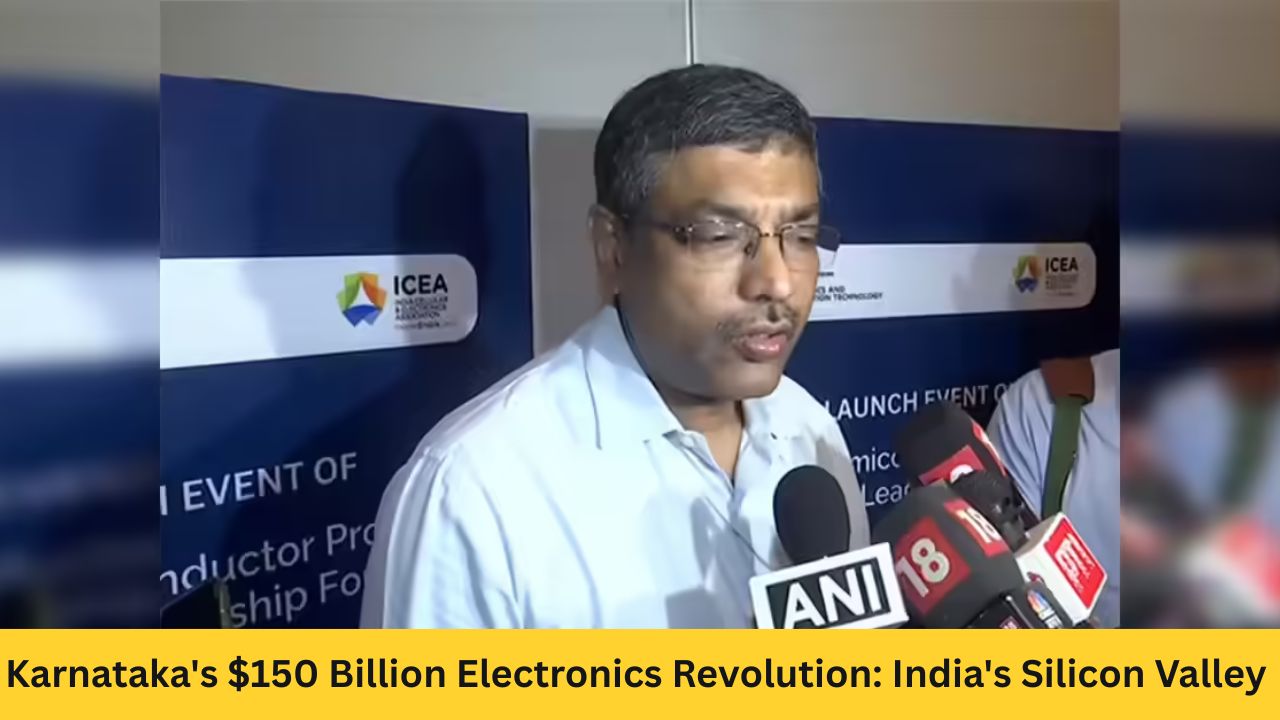
Karnataka stands at the forefront of India’s technological transformation, unveiling an ambitious vision document aimed at attracting a staggering $150 billion in investments for mobile and electronics components manufacturing and design. This strategic initiative positions the state as a global hub for electronics production, leveraging its established strengths in IT and innovation. With Bengaluru already known as India’s Silicon Valley, this push signals a massive expansion into hardware manufacturing, promising job creation, economic growth, and a stronger position in the international supply chain.
The vision document outlines a comprehensive roadmap to draw investments from leading global players in semiconductors, mobile devices, displays, and consumer electronics. By focusing on end-to-end manufacturing—from design and R&D to assembly and testing—Karnataka aims to capture a significant share of the projected $1 trillion global electronics market by 2030. This move comes at a critical time when global supply chains are diversifying away from traditional hubs, creating opportunities for agile regions like Karnataka.
Current Landscape of Electronics Manufacturing in Karnataka
Karnataka has long been synonymous with software services, hosting over 7,000 tech firms and generating more than $50 billion in IT exports annually. However, the state recognizes the need to pivot toward hardware to sustain long-term growth. Currently, electronics manufacturing contributes around 15% to the state’s industrial output, with key players like Foxconn, Dixon Technologies, and Flex operating large facilities.
The sector employs over 300,000 people directly, but this is just the beginning. Recent developments include the establishment of semiconductor design centers and component fabrication units, supported by incentives from the Karnataka Industrial Areas Development Board. Bengaluru’s ecosystem, bolstered by institutions like the Indian Institute of Science and premier engineering colleges, provides a ready talent pool of over 1.5 million engineers annually.
Key Stats on Karnataka’s Electronics Sector
| Metric | Current Figure | Projected Growth by 2030 |
|---|---|---|
| Investment Target | $150 billion | Full realization |
| Direct Jobs Created | 300,000+ (current) | 2 million+ |
| Export Contribution | $10 billion annually | $100 billion+ |
| Manufacturing Units | 500+ | 5,000+ |
| R&D Centers | 200+ | 1,000+ |
These figures underscore the transformative potential, with the state government projecting a 20% annual growth rate in electronics GDP contribution.
Strategic Components of the Vision Document
The vision document is a meticulously crafted blueprint spanning the next decade, emphasizing policy reforms, infrastructure development, and ecosystem building. It prioritizes attracting anchor investors—global giants like Apple, Samsung, and TSMC—who can anchor smaller suppliers and create cluster effects.
Key pillars include streamlined land acquisition, single-window clearances, and fiscal incentives such as capital subsidies up to 30% on investments, power tariff rebates, and tax holidays for 10 years. The document also stresses skill development, aiming to train 500,000 workers in advanced manufacturing techniques like chip fabrication and PCB assembly through partnerships with global training institutes.
Investment Incentives Breakdown
| Incentive Type | Details | Maximum Benefit |
|---|---|---|
| Capital Subsidy | 20-30% on fixed assets | $50 million per project |
| Land Cost Reimbursement | Up to 50% for eligible parks | Varies by location |
| Power Tariff Rebate | 25% reduction for 5 years | Ongoing savings |
| GST Reimbursement | Full on output for 7 years | Significant cash flow boost |
| Skill Development Grant | 50% cost coverage for training | $10,000 per worker |
These measures are designed to make Karnataka more competitive than rivals like Tamil Nadu and Gujarat.
Infrastructure and Ecosystem Development
To support $150 billion in investments, Karnataka is fast-tracking world-class infrastructure. The state plans to develop 20 new electronics manufacturing clusters (EMCs) across Bengaluru, Mysuru, Hubballi, and Mangaluru, equipped with plug-and-play facilities, clean rooms, and logistics hubs. A dedicated Electronics System Design and Manufacturing (ESDM) policy allocates $5 billion for common infrastructure like testing labs and logistics parks.
Proximity to Chennai’s port and Hyderabad’s airport enhances connectivity, while the upcoming Jewar Aerospace Park in Bengaluru will cater to electronics for aviation and defense. Water and power security are addressed through dedicated industrial corridors with renewable energy mandates—aiming for 50% green power by 2030.
The vision also fosters innovation through a $1 billion fund for startups in semiconductors and IoT devices, with incubators linked to global venture capital. Collaborations with Taiwan’s SEMICON and Japan’s JETRO will bring technology transfer and joint ventures.
Global Supply Chain Shift and Karnataka’s Opportunity
The world is undergoing a tectonic shift in electronics supply chains, driven by geopolitical tensions, pandemics, and the push for resilience. China, which dominates 60% of global electronics production, faces tariffs and restrictions, opening doors for India. Karnataka’s English-speaking workforce, democratic stability, and time-zone alignment with the US and Europe make it an ideal alternative.
India’s Production Linked Incentive (PLI) scheme, with $10 billion allocated for electronics, aligns perfectly with Karnataka’s vision. The state has already secured $20 billion in PLI commitments, including Apple’s iPhone assembly ramp-up to 25% of global production by 2028. Analysts predict Karnataka could capture 40% of India’s $300 billion electronics market by 2030.
Comparative Advantages Over Competitors
| Factor | Karnataka Advantage | Comparison to Rivals |
|---|---|---|
| Talent Pool | 1.5M engineers/year | Highest in India |
| IT Ecosystem | $50B exports | Foundation for hardware |
| Policy Stability | Consistent incentives | More predictable than others |
| Logistics | Airport + port proximity | Superior connectivity |
| Cost of Living | Competitive wages | Lower than Tamil Nadu |
Job Creation and Socio-Economic Impact
The $150 billion infusion is poised to generate 2 million direct jobs and 5 million indirect ones, transforming rural economies in North Karnataka and coastal regions. Women, who form 40% of the current electronics workforce, will benefit from targeted skilling in soldering, testing, and quality control.
Economic multipliers suggest every $1 invested could generate $3.5 in GDP, pushing Karnataka’s economy past $500 billion by 2030. This includes boosting MSMEs, which will supply 60% of components locally, reducing import dependence from 80% to 40%.
Socially, the vision incorporates ESG standards—mandatory rainwater harvesting, zero-liquid discharge, and community skill centers—to ensure sustainable growth.
Challenges and Mitigation Strategies
No ambitious plan is without hurdles. Land acquisition delays, power shortages, and skill gaps pose risks. Karnataka’s response includes a land bank of 50,000 acres, renewable energy auctions for 10 GW capacity, and a $2 billion skill mission training 1 million youth.
Global chip shortages and US-China trade wars add uncertainty, but diversification into wearables, EVs, and medical devices hedges risks. The state is also courting FDI from Korea, Vietnam, and the EU to balance dependencies.
Partnerships and Global Collaborations
Karnataka is forging ties with industry leaders. Memorandums of Understanding (MoUs) with Qualcomm for 5G chip design, Micron for memory fabs, and Vedanta-Foxconn for display panels are in advanced stages. The Karnataka Innovation Authority will oversee joint R&D with MIT and Stanford, focusing on AI-integrated electronics.
International roadshows in Taipei, Seoul, and Silicon Valley aim to secure $50 billion in the first five years.
Future Outlook and Success Metrics
By 2035, Karnataka envisions contributing 25% to India’s electronics exports, rivaling Vietnam and Mexico. Success will be measured by investment inflows, job numbers, and export values, with annual reviews to adapt the vision.
This initiative not only elevates Karnataka but positions India as the third-largest electronics manufacturer globally, behind only China and the US.
Conclusion: Karnataka’s Electronics Ascendancy
Karnataka’s $150 billion vision document is more than a plan—it’s a manifesto for industrial renaissance. By blending policy innovation, infrastructure prowess, and global partnerships, the state is rewriting India’s tech narrative from services to manufacturing supremacy. As investments flow and factories rise, Karnataka won’t just target $150 billion—it will redefine electronics on the world stage, creating prosperity for generations.

Marion (Ronnie) Serrano is a dedicated news writer focused on breaking stories, community issues, and real-time updates. With a strong eye for accuracy and clarity, Ronnie delivers reporting that informs and empowers readers. Passionate about public affairs and human-interest stories, Ronnie brings depth to every article. Outside the newsroom, Ronnie enjoys exploring new perspectives and engaging with local communities.