
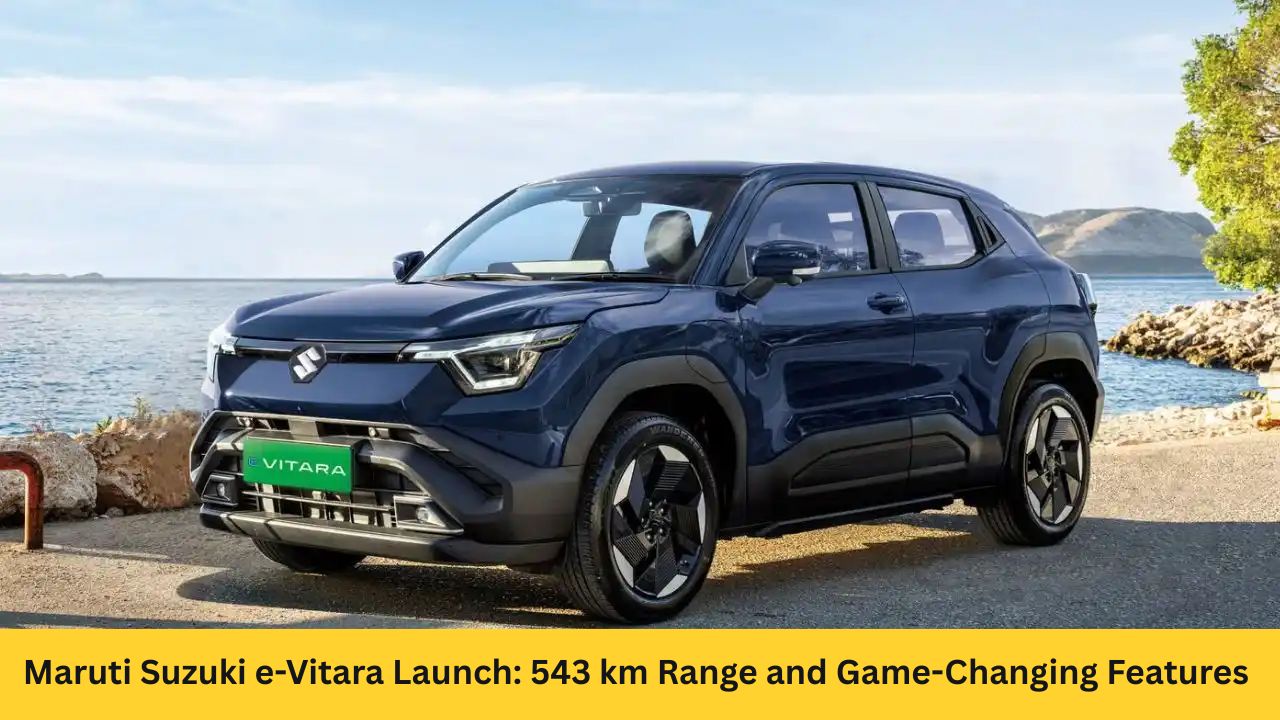
Maruti Suzuki, India’s largest carmaker, has officially unveiled the e-Vitara, its first full-fledged electric SUV poised to dominate the growing EV market. This mid-size SUV promises a certified range of up to 543 km on a single charge for the India-spec model, making it one of the most practical electric vehicles for Indian roads. Coupled with the innovative Battery-as-a-Service (BaaS) strategy, the e-Vitara eliminates the biggest barrier to EV adoption—high upfront costs—by offering battery subscription plans that drastically reduce ownership expenses. Priced competitively starting around Rs 20-25 lakh, the e-Vitara targets urban families, highway commuters, and eco-conscious buyers, blending Maruti’s renowned reliability with cutting-edge electric technology.
The launch comes at a pivotal time as India’s EV market surges, with sales projected to reach 10 lakh units annually by 2027. Maruti aims to capture 50% of this segment through its e-Vitara lineup, leveraging its vast service network of over 4,000 touchpoints. This model not only challenges rivals like Tata Nexon EV and MG ZS EV but sets new benchmarks in affordability, range, and serviceability.
e-Vitara’s Impressive Range and Battery Technology
At the heart of the e-Vitara is a robust 60 kWh lithium-iron-phosphate (LFP) battery pack, engineered for longevity and safety. The ARAI-certified range of 543 km positions it ahead of most competitors, ensuring worry-free long drives across India’s diverse terrains—from city traffic to Himalayan highways. Real-world tests suggest 400-450 km usability, factoring in AC usage, speed, and load.
The dual-motor all-wheel-drive (AWD) variant delivers 135 kW power and 340 Nm torque, accelerating from 0-100 kmph in under 8 seconds. Front-wheel-drive (FWD) options offer similar punch with better efficiency. Fast charging capabilities allow a 20-80% top-up in just 30 minutes using 150 kW DC chargers, while home AC charging takes 7-8 hours. Maruti claims the battery retains 80% capacity after 2 lakh km or 10 years, backed by an 8-year warranty.
Range Comparison Table
| Model Variant | Battery Capacity | ARAI Range (km) | Real-World Range (km) | 0-100 kmph (sec) |
|---|---|---|---|---|
| e-Vitara FWD Base | 49 kWh | 450 | 350-380 | 9.5 |
| e-Vitara FWD Mid | 60 kWh | 543 | 420-460 | 8.5 |
| e-Vitara AWD Top | 60 kWh | 500 | 380-420 | 7.8 |
| Tata Nexon EV Max | 40.5 kWh | 465 | 350-380 | 8.9 |
| MG ZS EV Essence | 50.3 kWh | 461 | 360-390 | 8.3 |
This table highlights e-Vitara’s edge in range and performance, making it ideal for India’s range-anxious buyers.
Battery-as-a-Service (BaaS): Redefining EV Affordability
Maruti’s BaaS model is the e-Vitara’s standout feature, slashing the ex-showroom price by 25-30% to as low as Rs 16-18 lakh for the base battery-less variant. Customers pay a monthly subscription of Rs 3,500-5,000 for the battery, covering usage, maintenance, and replacements. This mirrors smartphone plans but for EVs, where the battery—typically 40% of vehicle cost—is rented separately.
Under BaaS, Maruti handles battery health monitoring via over-the-air (OTA) updates and swaps aging units at no extra cost. Subscribers enjoy unlimited km limits in the first year, with flexible plans thereafter. Non-BaaS buyers purchase the full package for outright ownership. This strategy targets budget-conscious buyers, fleet operators, and ride-hailing services, potentially boosting EV penetration to 20% by 2030.
BaaS Cost Breakdown Table
| Ownership Model | Upfront Cost (Rs Lakh) | Monthly Battery Fee (Rs) | Total 5-Year Cost (Rs Lakh) | Ideal For |
|---|---|---|---|---|
| Full Purchase | 22-28 | None | 25-32 | Long-term owners |
| BaaS Base Plan | 16-18 | 3,500 | 28-30 | Budget buyers |
| BaaS Premium Plan | 18-20 | 4,500 (incl. insurance) | 30-33 | Fleets & high usage |
BaaS could save users Rs 4-6 lakh over five years compared to traditional financing, factoring in lower running costs of Rs 1-1.5 per km versus Rs 7-8 for petrol SUVs.
Design, Features, and Interior Comfort
The e-Vitara sports a bold, futuristic design with Suzuki’s new “Heart-Tech” language—sharp LED headlights, connected tail lamps, and 18-inch alloys. Its 4.3-meter length and 2,735 mm wheelbase ensure spaciousness for five passengers, with a 400-liter boot expandable to 1,000 liters.
Inside, a 12.3-inch touchscreen dominates, supporting wireless Android Auto/Apple CarPlay, OTA updates, and ARKAMYS audio. Dual-zone climate control, ventilated seats, and a panoramic sunroof elevate luxury. Safety shines with 6 airbags, 360-degree cameras, ADAS Level 2 (adaptive cruise, lane keep), and a 5-star Bharat NCAP rating. Maruti’s Heartect-e platform enhances structural rigidity by 30% for crash protection.
Performance and Driving Dynamics
Powered by a permanent magnet synchronous motor, the e-Vitara offers seamless one-pedal driving with regenerative braking. It handles highways effortlessly at 120 kmph and navigates urban potholes via a multi-link rear suspension. Ground clearance of 200 mm suits Indian roads, while AWD variants add traction for monsoons and hills.
Regenerative modes—Eco, Normal, Sport—optimize range and fun. Maruti promises minimal NVH, with cabin noise under 60 dB at highway speeds.
Charging Infrastructure and Ecosystem Support
Maruti addresses range anxiety with a nationwide network plan: 10,000 fast chargers by 2027 via partnerships with ChargeZone and Statiq. Home wallboxes (7.2 kW) come free with BaaS. The mySuzuki app enables charger locator, preconditioning, and remote monitoring.
India’s EV ecosystem benefits from falling battery prices (down 20% YoY) and PLI schemes, positioning e-Vitara as a volume leader.
Running Costs and Ownership Economics
E-Vitara owners save massively: electricity costs Rs 1.2/km vs Rs 8/km for diesel. Maintenance drops 40% sans oil changes, with service intervals at 15,000 km. Resale value holds strong due to LFP batteries’ durability. Total ownership cost over 5 years/1 lakh km: Rs 12-15 lakh vs Rs 20-25 lakh for petrol rivals.
Ownership Cost Comparison (5 Years/1 Lakh km)
| Parameter | e-Vitara BaaS | Brezza Petrol | Creta Diesel |
|---|---|---|---|
| Purchase + Battery | 28 | 25 | 28 |
| Fuel/Electricity | 12 | 70 | 55 |
| Maintenance | 8 | 15 | 12 |
| Insurance | 10 | 10 | 11 |
| Total | 58 | 120 | 106 |
Savings exceed Rs 50,000 annually for average users.
Environmental Impact and Sustainability
The e-Vitara cuts CO2 emissions by 70% over petrol SUVs, aligning with India’s 30% EV sales target by 2030. Maruti’s gigafactory in Gujarat (50 GWh capacity) ensures local sourcing, reducing import reliance. Recyclable materials comprise 95% of interiors, supporting circular economy goals.
Competitive Landscape and Market Positioning
Facing Tata’s 60% EV share, Maruti leverages scale for aggressive pricing. Variants cater to all: base for cities, AWD for adventurers. Exports to Japan/Europe start 2026, boosting forex.
Customer Support and After-Sales
Maruti’s 4,500+ service centers offer dedicated EV bays, trained technicians, and 3-year/1 lakh km warranty (extendable). Roadside assistance covers towing to chargers.
Future Roadmap and Variants
Maruti plans six EV models by 2030, including Fronx EV and Grand Vitara hybrid. e-Vitara facelifts promise solid-state batteries for 700 km range by 2028.
Conclusion: Why e-Vitara Redefines EV Ownership
The Maruti e-Vitara with 543 km range and BaaS ushers in affordable, practical electromobility for India. By slashing costs, ensuring range confidence, and backing with unmatched service, it democratizes EVs for millions. As infrastructure grows, e-Vitara positions Maruti to lead India’s green revolution, blending innovation, value, and Suzuki’s trusted legacy.

Marion (Ronnie) Serrano is a dedicated news writer focused on breaking stories, community issues, and real-time updates. With a strong eye for accuracy and clarity, Ronnie delivers reporting that informs and empowers readers. Passionate about public affairs and human-interest stories, Ronnie brings depth to every article. Outside the newsroom, Ronnie enjoys exploring new perspectives and engaging with local communities.