
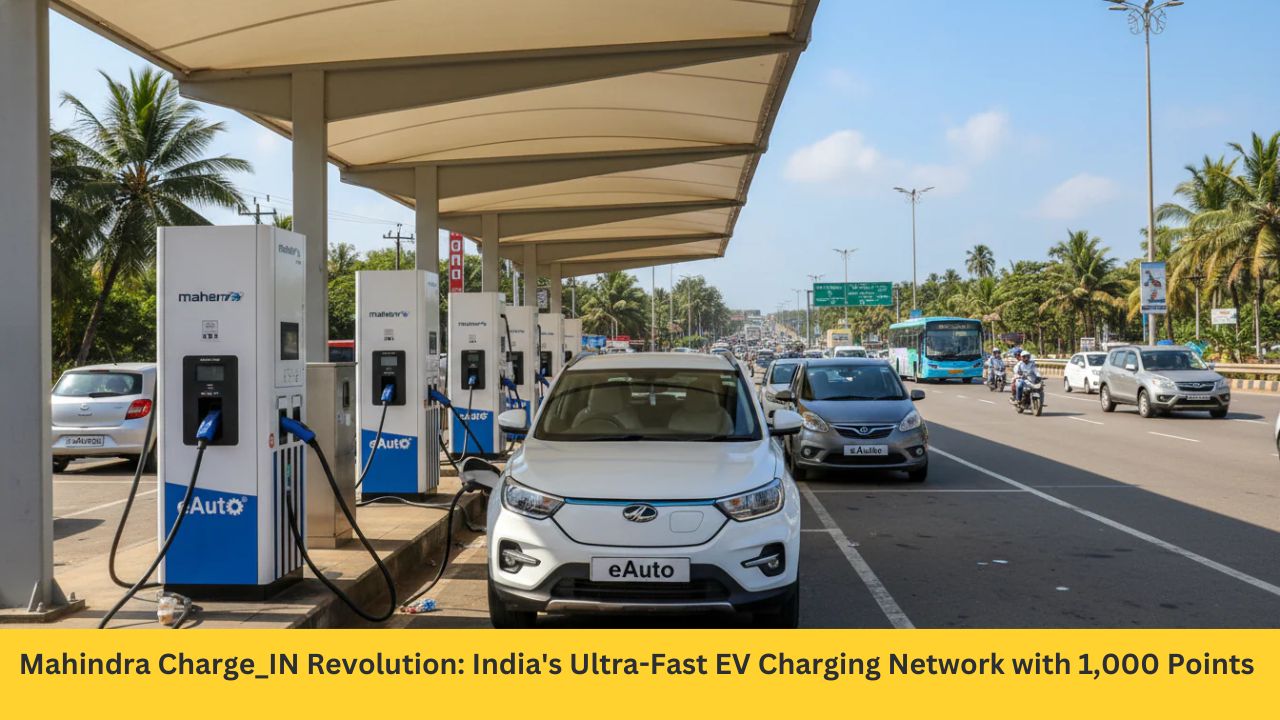
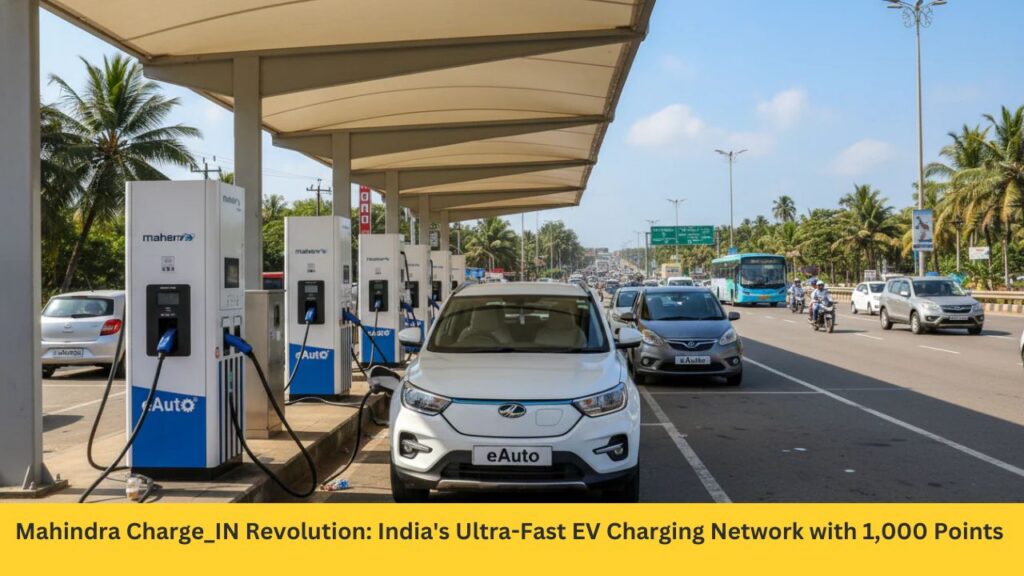
Mahindra has taken a bold step forward in India’s electric vehicle revolution by launching its proprietary Charge_IN ultra-fast charging network. Announced on November 25, 2025, the initiative promises to establish 250 charging stations equipped with 180 kW chargers, creating over 1,000 charging points by the end of 2027. This move aligns perfectly with the government’s push to bolster public EV infrastructure, addressing one of the biggest barriers to widespread EV adoption: range anxiety on long highway journeys. The first two stations are already operational, marking the beginning of what could become India’s high-speed EV charging backbone.
What Makes Charge_IN Stand Out
Charge_IN stations feature cutting-edge 180 kW dual-gun chargers capable of simultaneously charging up to four electric vehicles. Designed exclusively for four-wheelers, these chargers can boost Mahindra’s eSUV lineup—including the XEV 9e, BE 6, and upcoming XEV 9S—from 20% to 80% in just 20 minutes. This rapid charging capability transforms long-distance travel, making electric drives as convenient as traditional fuel stops. Stations are strategically co-located with wayside amenities like restaurants and cafes, allowing drivers to grab a coffee while their vehicle recharges seamlessly.
The network emphasizes universality, welcoming EVs from all brands, not just Mahindra. This open-access model fosters collaboration in the EV ecosystem, encouraging broader adoption across India.
Key Technical Specifications
| Feature | Details |
|---|---|
| Charger Power | 180 kW dual-gun per station |
| Simultaneous Charging | Up to 4 EVs at once |
| Charge Time (20-80%) | 20 minutes for Mahindra eSUVs |
| Total Stations Planned | 250 by 2027 |
| Total Charging Points | Over 1,000 |
| Location Focus | Major highway corridors |
Strategic Locations and Rollout Plan
The inaugural Charge_IN stations kicked off in high-traffic corridors: one in Hoskote on NH 75 (Bengaluru-Chennai highway) and another in Murthal on NH 44 (about 50 km from Delhi). These spots were chosen for their proximity to bustling highways where long-haul drivers need reliable pit stops. Mahindra plans to replicate this model nationwide, prioritizing NH networks that connect major cities like Mumbai-Delhi, Chennai-Bengaluru, and Kolkata-Hyderabad.
By 2027, the 250 stations will form a robust grid, reducing average gaps between chargers to under 100 km on key routes. This expansion supports India’s ambitious target of 30% EV penetration by 2030, where public infrastructure plays a pivotal role.
Accessing Charge_IN: User-Friendly Apps and Integration
Mahindra eSUV owners can locate, initiate, and pay for charges via the intuitive Me4U app, which already aggregates around 34,000 public charging points from various operators. Non-Mahindra EV drivers have equal access through the dedicated “Charge_IN by Mahindra” app or leading aggregator platforms. Features include real-time availability, navigation, session tracking, and seamless payments, ensuring a hassle-free experience.
This digital integration reflects Mahindra’s holistic approach, blending hardware with smart software to build user confidence in EVs.
App Features Comparison
| App Name | Primary Users | Key Integrations |
|---|---|---|
| Me4U | Mahindra EV owners | 34,000+ points, Charge_IN exclusive |
| Charge_IN by Mahindra | All EV brands | Aggregators, real-time status |
| Third-Party Aggregators | Universal | Multi-brand compatibility |
Why Charge_IN Matters for India’s EV Landscape
India’s EV market is exploding, with sales surpassing 2 million units in 2025 alone—a 50% jump from the previous year. Yet, fragmented charging infrastructure remains a pain point, with only about 12,000 public fast chargers nationwide. Mahindra’s Charge_IN directly tackles this by focusing on ultra-fast 180 kW tech, which is 3-4 times faster than standard 50 kW units. For context, a typical highway journey from Delhi to Mumbai (1,400 km) could now involve just 7-8 Charge_IN stops, versus 15+ on slower networks.
The initiative also boosts highway economies, as amenities at stations drive footfall to local businesses. Environmentally, it accelerates the shift from fossil fuels, potentially cutting CO2 emissions by millions of tons annually as more EVs hit the roads.
Mahindra’s Vision: UNLIMIT Electric Mobility
Mahindra’s leadership envisions Charge_IN as more than chargers—it’s a promise of “effortless and reliable” long-haul EV travel. By aligning with national priorities, the company positions itself as a leader in sustainable mobility. This launch complements Mahindra’s born-electric eSUV portfolio, which has already garnered over 50,000 bookings since debut. Future expansions may include solar-powered stations and V2G (vehicle-to-grid) capabilities, further innovating the space.
Challenges and Future Prospects
Building 1,000 points in two years isn’t without hurdles: land acquisition along highways, grid upgrades for high-power delivery, and competition from rivals like Tata Power and BPCL. Mahindra mitigates these through partnerships and phased rollouts. By 2027, Charge_IN could capture 10-15% of India’s fast-charging market, setting benchmarks for speed and accessibility.
Stats highlight the growth potential: India’s EV charging demand is projected to hit 15 million points by 2030, with highways accounting for 40%. Mahindra’s early mover advantage could redefine inter-city travel.
Impact on EV Owners and the Economy
For daily commuters and road-trippers, Charge_IN means fewer stops and more range per charge—up to 300-400 km added in 20 minutes. Families embarking on vacations will appreciate the family-friendly amenities, turning recharges into mini-breaks. Economically, each station could generate jobs in maintenance, operations, and hospitality, injecting vitality into rural highway belts.
| EV Adoption Stats India 2025 | Figures |
|---|---|
| Total EV Sales | Over 2 million units |
| Public Fast Chargers | ~12,000 |
| Projected Need by 2030 | 15 million points |
| Highway Share | 40% of demand |
Conclusion: Charging Towards a Greener Future
Mahindra’s Charge_IN network isn’t just infrastructure—it’s a catalyst for India’s EV dreams. With 1,000 ultra-fast points by 2027, it promises to erase range anxiety, empower all EV brands, and propel sustainable travel. As the first stations light up highways, they signal a brighter, electrified tomorrow. EV enthusiasts, download those apps and hit the road—India’s charging revolution has begun.

Marion (Ronnie) Serrano is a dedicated news writer focused on breaking stories, community issues, and real-time updates. With a strong eye for accuracy and clarity, Ronnie delivers reporting that informs and empowers readers. Passionate about public affairs and human-interest stories, Ronnie brings depth to every article. Outside the newsroom, Ronnie enjoys exploring new perspectives and engaging with local communities.